|
|
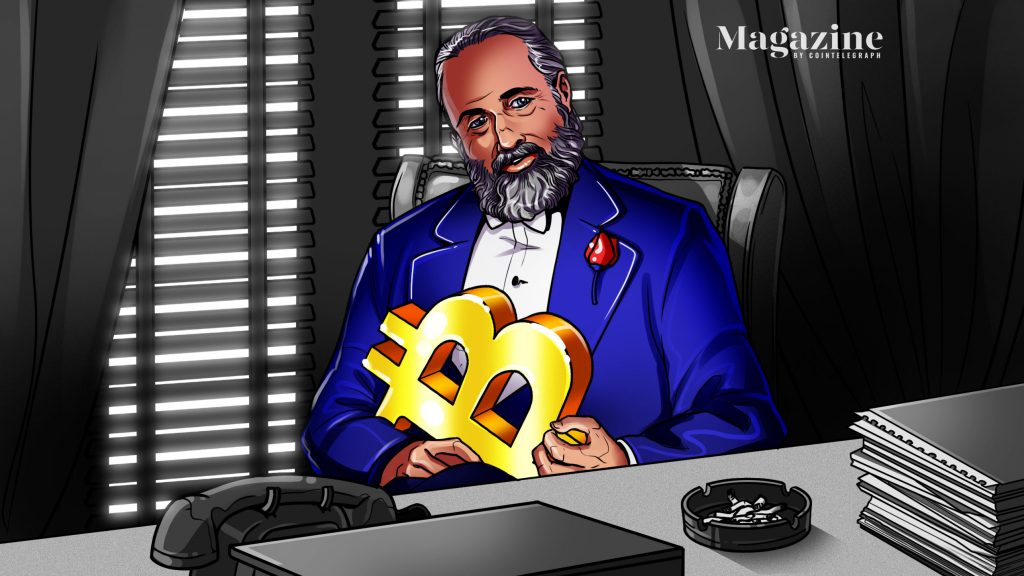
Widely credited as the inventor of digital cash, David Chaum is sometimes known as the “father of online anonymity” or the “godfather of cryptocurrency,” whose work inspired the near-mythical group called the Cypherpunks from which Bitcoin emerged.
Beginning his studies in computer science in the late 1970s, when encryption was classified at the same level as nuclear technology, Chaum quickly realized that the technology would be crucial to ensure the continuation of privacy and democracy in the digital age. More recently, he founded xx Network, a privacy-focused blockchain whose connected xx Messenger Chaum hopes will withstand attacks even by quantum computers of the future.
“The National Security Agency was taking the position that cryptography was born classified, even if you created it yourself — like nuclear weapons technology,” Chaum recalls. He was told around 1980 that conferences on the subject would naturally not be allowed and that “people who organize them would be prosecuted.”
“I was risking spending the rest of my life in jail,” he says.
Cyberwar
Encryption has long been of vital importance in warfare, and the Allies breaking the cipher of the Enigma machine and decoding the Nazis’ secret messages changed the course of World War II.
Afterward, the United States government regulated cryptography as a military munition alongside nuclear technology. The 1976 invention of public key encryption, which allowed information to be shared between two parties without a mutual encryption and decryption key, which could not be cracked or intercepted, took away governments’ monopoly on the technology. The cat was out of the bag, as they say.
As a computer science graduate student at the University of California, Berkeley in 1977, Chaum, now 67, recalls how he “started thinking how important privacy would be for the upcoming digital world” and, by extension, for democracy.
Privacy was the default state in those analog days, with surveillance such as listening to conversations, intercepting mail or searching for records requiring active and concentrated effort. With digitalization, surveillance no longer needed to be active, as data could be more easily searched, cross-referenced and stored for later use. Chaum came to the “fundamental realization that cryptography was the only way to protect privacy in cyberspace,” he recalls.
“That’s when I realized it was important to organize a conference on cryptography,” he says with a laugh, fully recognizing the absurdity. The result was the International Association for Cryptologic Research, which continues to organize conferences several times a year. “I called it crypto — the conference was called Crypto 81,” he notes.

He was the first person to describe cryptographic money in his 1983 paper, “Blind signatures for untraceable payments,” which led to the creation of short-lived Ecash by his company DigiCash from 1995 to 1998, as well as the invention of blind signatures, a type of digital signature used in Bitcoin and other cryptocurrencies.
It is notable that some cryptographers, such as Matthew D. Green, have aired grievances with the word “crypto” coming to stand for, and even being soiled by, cryptocurrency, thus disrespecting its original meaning of “encryption.”
Chaum takes the opposite view. “It’s so exciting to me because it’s bringing what was an archaic, esoteric, highly technical, mathematical, possibly classified technology area into widespread appreciation, so on contrary, I’m happy” to see the word “crypto” get new life.
“Crypto” means cryptography. Not that other thing. https://t.co/yaLOOCyx8d
— Matthew Green (@matthew_d_green) November 23, 2017
Backed by privacy
Among the most remarkable aspects of Chaum’s work is that his 1985 paper “Security without Identification: Transaction Systems to Make Big Brother Obsolete” is credited as providing the spark from a privacy-focused group in 1992 that began calling themselves the Cypherpunks.
Princeton’s Arvind Narayanan wrote about the group:
“[This movement], which originated in the late ’80s, took Chaum’s ideas and ran quite far with them in terms of rhetoric—in an explicitly subversive direction. For cypherpunks, crypto was at the core of a vision of how technology would cause sweeping social and political change, weakening the power of governments and established institutions… Anonymous digital cash, one of the key parts of Chaum’s proposal, by itself has political significance in that it offers an alternative to government-backed currencies.”
After several unsuccessful attempts at digital cash by various members of the Cypherpunks, the Bitcoin white paper by Satoshi Nakamoto emerged in 2008. He was soon contacted by fellow member Hal Finney, who went on to receive the first Bitcoin transaction on Jan. 9, 2009. As such, Chaum is appropriately labeled the godfather of cryptocurrency.
But Chaum wants to go further with private, uncrackable payments. In order to have real privacy in the modern age, Chaum explains that actions must be un-linkable both to the individual (vertical un-linkability) and to each other (horizontal un-linkability), meaning that individual actions must exist within a data vacuum of sorts. Unlike PayPal or credit cards, cryptocurrencies like Bitcoin and Ether are not directly linked to the real identities or IP addresses of users — the transactions themselves are, however, linked to each other, and publicly so.
To have real privacy in payments, Chaum reasons, “you need to use a different pseudonym with each entity you interact with,” so as to ensure that nobody can keep a dossier on a particular anonymous identity. Taking the next step from privacy coins such as Monero and Zcash, Chaum’s xx Network is working on xx Coin to enable quantum-resistant private payments.
"The difference between a bad electronic cash system and a well-developed digital cash will determine wether we will have a dictatorship or a real democracy." Crypto pioneer David Chaum in 1996 #bitcoin pic.twitter.com/jiNh9TCqsf
— BankSith (@banksith_lord) July 18, 2022
A vision for governance
Chaum is clear in his belief that “the only effective way to maintain any level of privacy is to control the information with your own keys” and goes on to explain that continuous government leaks suggest that any information entrusted with others can become public at any time.
“All those leaks are forever, and they can be aggregated and amalgamated.
Unlike the criticism leveled at the Cypherpunks he inspired, Chaum denies being an ideologue, saying his views are based on practicality, as people need to have a credible assurance of privacy.
Chaum argues that privacy, over the long term, is critical for a functional democracy because “you cannot be a citizen of a democracy without the ability to communicate freely,” bringing up a story about how when coffee was introduced in Europe around the time of the enlightenment, it was hated by kings as it encouraged people to spend their evenings discussing politics.